
Every growth-stage founder and CMO eventually hits the exact same wall. Your business is moving at full sprint. Product roadmaps update weekly, sales teams need collateral yesterday, and the board has made the mandate clear: hit your numbers, but keep headcount lean.
So you turn to the traditional playbook. You bring on a lean internal team, line up a couple of specialized freelancers, and sign a retainer with a traditional agency. Then reality sets in.
Instead of accelerating, you end up wrangling five different vendors who operate in total silos. The agency needs a month just to get up to speed, every minor shift in direction comes with extra scoping fees, and your executives spend their days repeating basic context instead of building momentum. The takeaway is simple: traditional retainer models were built for a slow, predictable corporate environment that no longer exists.
In a recent leadership session, our COO, Tina Mirfarsi, unpacked why this model breaks down, where the hidden costs live, and why high-growth brands need a full-service, Swiss-Army knife partner like Creative Blue in their corner.
1. The Real Cost of Vendor Fragmentation
There is the visible cost of hiring multiple agencies, and then there are the hidden operational costs. Beyond the monthly retainer, you pay for the friction, lost time, and narrative dilution that happen when work gets carved up across silos. In the traditional model, marketing can look like a web of handoffs:
- Agency A shapes high-level brand strategy.
- Agency B manages paid ads and creative testing.
- Agency C handles PR or technical SEO.
And the list goes on and on. Meanwhile your internal teams are juggling each agency, checking for consistency, while maintaining their list of tasks they aren’t outsourcing.
"Having spent nearly two decades on the corporate side, I know how challenging it can be to manage five separate vendors, " says Tina Mirfarsi. "You spend hours repeating the same strategic context. By the end of the day, you’ve re-explained your vision five different times, sometimes at the expense of moving the business forward."
Every handoff is an opportunity for details to slip. The narrative gets watered down, deadlines drag, and the conviction behind your investor pitch never makes it into your day-to-day customer marketing.
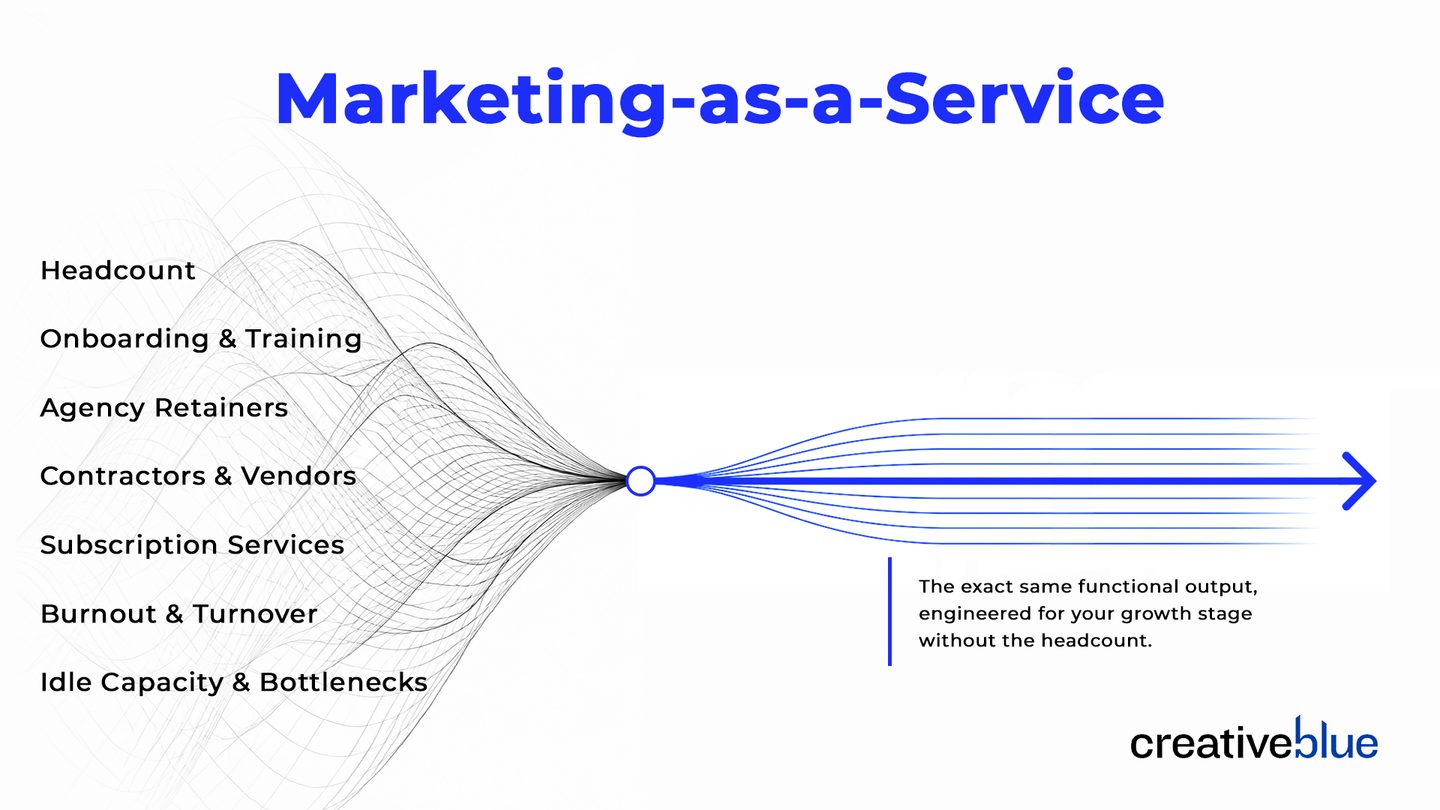
2. The Headcount Math: $450k+ vs. Modern Flexibility
When leadership teams look to expand capacity in-house, they often underestimate the actual cost of full-time headcount. To build a complete marketing engine internally, a business usually needs:
- Senior Marketing Leadership (VP or fractional CMO): $250,000 to $350,000 annually.
- Dedicated Design and Copywriting: $150,000 to $220,000 annually.
- Technical Execution (Web, SEO, Analytics): $120,000+ annually.
- Benefits, Recruiting Fees, and Payroll Tax: A 25% to 35% overhead multiplier.
- Tooling, Tech Stack, and Subscriptions: $30,000+ annually.
Building that team in-house runs between $550,000 and $750,000 every year. A huge chunk of that investment gets eaten up by recruiting cycles, administrative drag, and idle capacity between major launches.
The Full-Service Alternative
Marketing-as-a-Service (MaaS) eliminates fixed overhead and rigid retainer bloat by embedding senior strategic firepower alongside on-demand execution under one roof.
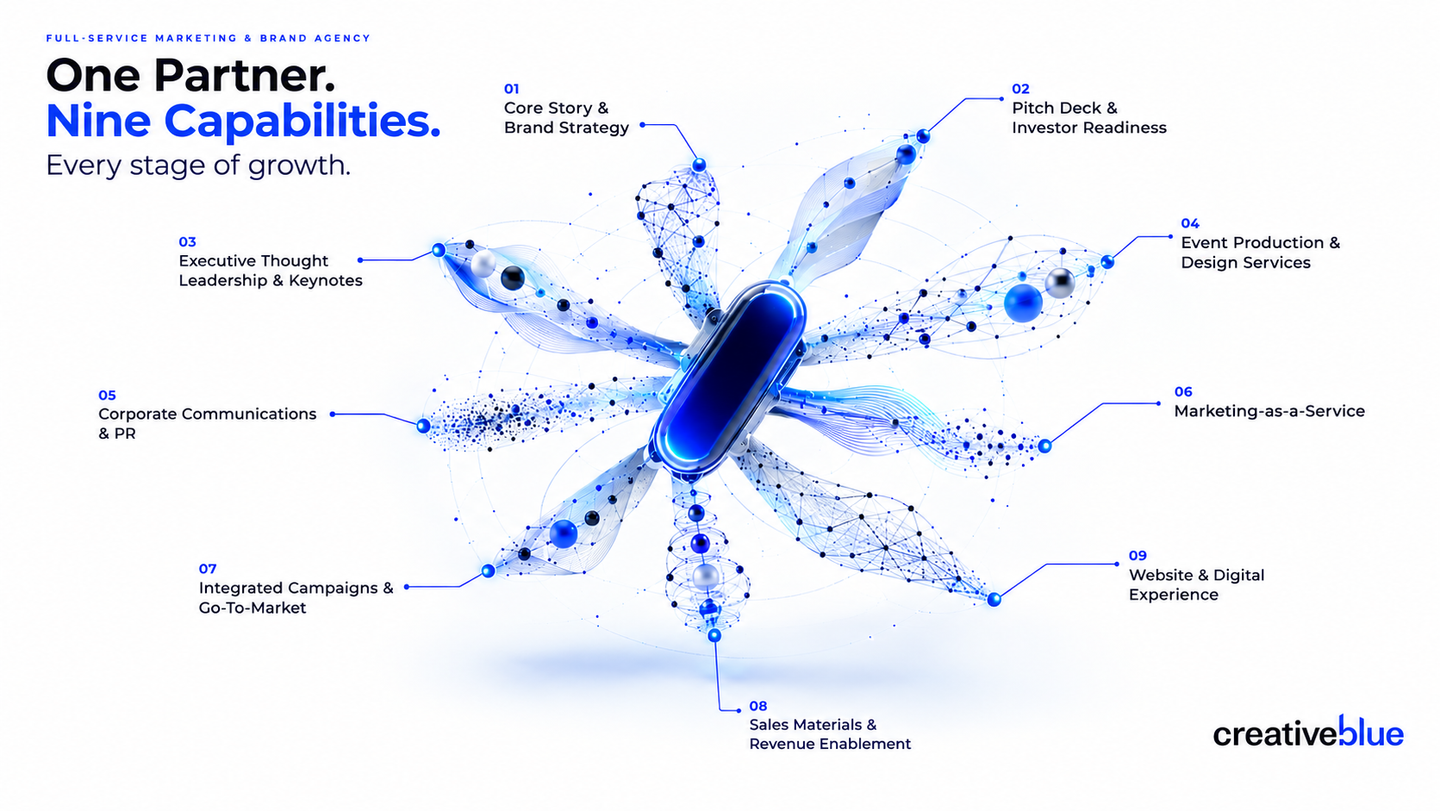
Instead of juggling multiple specialized firms or hiring a massive department, Creative Blue operates as a full-service embedded partner. Our clients get senior executive direction from seasoned leaders from kickoff to delivery across pitch design, brand strategy, corporate communications, and digital campaigns.
Because legacy firms build their economics on billable hours. If you sign a traditional agreement in January for brand guidelines, but by March you need to update an investor deck for an upcoming round or launch an executive thought leadership push, traditional firms hit the brakes:
- "That falls outside our initial scope."
- "We will need to draft an addendum and price this out."
- "Our team requires a multi-week ramp to resource that."
In venture-backed and high-growth markets, that friction kills momentum.
"Growth companies need partners built to solve whatever problem is in front of them right now," Tina explains. "Whether our clients need a board deck, an executive keynote, a sales one-pager, or a website overhaul, we handle it. Our MaaS model adapts to the company’s priorities, not a static contract signed six months ago."
3. Moving Past "Turn-Off" Marketing
When market conditions tighten, marketing budgets are often the first to get cut. That happens because legacy agencies treat marketing as an isolated expense, pouring capital into ad spend without establishing a durable brand story or organic presence.
"If you rely entirely on paid spend without an authentic narrative or clear point of view, your pipeline dries up the moment you pause the budget,” says Chris. Ott, CEO. “By connecting Core Story & Brand Strategy, Pitch & Coaching, and Growth Acceleration via Marketing-as-a-Service into a single flywheel, Creative Blue is right there with you when priorities pivot; we scale and adapt execution dynamically so company momentum never stalls.”
Built for the Way Companies Actually Grow
Your leadership team should not spend its weeks wrangling vendors, negotiating new scopes, or translating brand vision between three different agencies.
Ready to eliminate vendor drag and build a modern marketing engine?
Connect with the Creative Blue team to audit your growth stack.